Interactive Vector Learning with Python and Streamlit
Vector algebra is a fundamental component of introductory mathematics, physics, and engineering courses. However, students often experience difficulties when connecting algebraic procedures with geometric representations, particularly when working with vectors in three dimensions.
Vector Learning was developed to address these challenges through an interactive web-based application built with Python and Streamlit. The project provides students with an adaptive learning environment where they can practice vector concepts and operations through automatically generated problems, immediate feedback, and unlimited attempts. This approach encourages students to learn from errors and progressively strengthen their conceptual and procedural understanding.
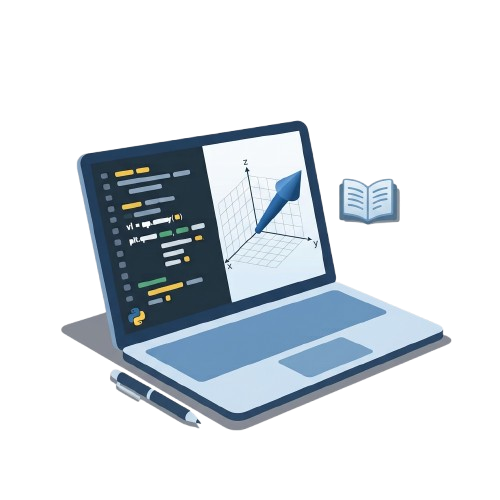
The application covers fundamental topics including the conceptual definition of vectors, vector components in two- and three-dimensional Cartesian coordinate systems, vector addition and subtraction, and scalar multiplication. Eight core exercise types are available, with alternative versions generated dynamically to maintain the same level of conceptual difficulty while varying the numerical conditions.
The activity was implemented with 155 first-year engineering students across seven groups. Student learning was evaluated through pre-test and post-test assessments administered through Canvas. The results showed an increase in the mean score from 71.69 to 77.97, together with a reduction in the standard deviation from 19.18 to 16.27. A paired-samples analysis also indicated a statistically significant learning gain, with a mean difference of 6.28 points and an effect size of Cohen’s d = 0.265.
Students also reported favorable perceptions of the application. Approximately 70–74% agreed that it helped them better understand vectors, made the learning process more interesting, or made the topic clearer. The qualitative responses identified three-dimensional visualization, together with the use of trigonometric functions and vector components, as some of the main challenges experienced by students.
The application was developed as part of the Educational Innovation in Physics initiative and presented at the 24th LACCEI International Multi-Conference for Engineering, Education, and Technology, held in Santiago, Chile, in July 2026.
For more details, please refers to the LACCEI paper.